Semiconductors and Sovereignty: China’s Five-Year Plan and the Fragmentation of Global Trade
By Charlie Cameron
Introduction:
When considering the most ambitious states on the global playing field, China arguably tops the list. Recent press releases regarding the government’s soon-to-be-unveiled 5 year plan stretching from 2026 to 2030 suggests they have no intention of slowing down. High speed economic growth has been highlighted as the overarching goal, with the key driver toward that target being progress in their technological sector, pushing for homegrown innovation leading to self-reliance.
China’s Current Positioning:
Semiconductors are a crucial element of China’s self-reliance plan. Semiconductors, often called chips, are tiny electronic circuits powering virtually all digital technology, serving as the ‘brain’ of any electronic device, used predominantly in computers and smartphones and key for AI processing. In 2022, China accounted for roughly 31% of global semiconductor sales, making it by far the largest single-country market in the world [1]. In 2024, they exported $48.3 billion (USD) of semiconductor devices, while in the same year they also imported $26.9 billion worth [2]. While the balance of trade itself is not a concern, it is China’s reliance on foreign imports of high-end chip technology and advanced AI chips that the government is desperate to curb over the next 5 years. Taiwan semiconductor giant TSMC continues to lead the way in AI chip production, and with China seeking to become a global leader in AI, beginning with their very own DeepSeek, they cannot continue to rely on overseas imports.
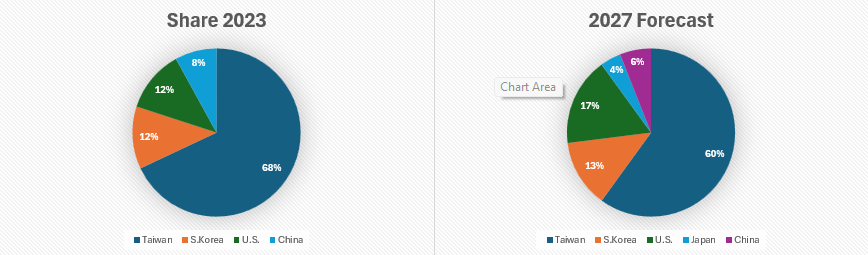
Source: TrendForce 2023, Market share of Semiconductor Industry by Nation
The charts demonstrate China’s market share in the advanced semiconductor industry in 2023, as well as the forecasted decrease in this already small market share if progression remains the same without any government intervention. However, their renewed focus on R&D, talent development, and vertical integration, particularly in advanced and AI chip manufacturing is set to change.
In this next 5 year plan, significant resources will be directed into addressing bottlenecks in the making of advanced semiconductors as foreign pressure mounts, particularly with the US preventing Nvidia from selling its most advanced Blackwell chips to China. Nvidia CEO Jensen Huang believes they are 10 years ahead of any other chip on the market. This kind of blockage will force China’s hand, deepening their desire and need for self-reliance in advanced chips most importantly. A similar situation occurred in September 2014, when China launched the China Integrated Circuit Industry Investment Fund, commonly known as the ‘Big Fund’, an initiative to boost China’s domestic semiconductor industry and reduce dependence on foreign chip technology. The implementation of this fund was accelerated in part due to tightened export controls by the U.S on their cutting-edge lithography, etching, and deposition tools to China [3].
Supply Chain Ramifications:
The continued drive toward semiconductor self-sufficiency from China will affect the global supply chain in this sector, likely through fragmentation and an increased pressure on competitors. The support for China’s domestic industry combined with ongoing export control from the US and allies will likely result in faster bifurcation, where parts of the global industry and supply chain will be forced to re-orient into China-centric and US/allied-centric supply chains. Despite potential fracturing, larger multinationals may spend more time dividing production footprints, for example, keeping advanced-node fabs in Taiwan or the U.S., while keeping mature-node capacity in China or other friendly countries. Unfortunately for firms, fragmentation can create complexity and cost duplication issues, and those without adequate resources or access to homegrown chip technology may fall behind as they are unable to keep up with pricing.
Pressure from China on global competitors through their aims to substitute imported capabilities could give the US and their partners incentive to coordinate their import and export controls to quell the sale of Chinese-made chips in the global market. This coordination could increase diplomatic pressure on equipment exporting allies, such as the Netherlands, Japan, and South Korea, to align with U.S led restrictions. Big companies reliant on Chinese business (ASML, Tokyo Electron, Lam Research) will be forced to make hard choices and whether priority is given to the political or economic implications of their allegiance. Given the regional economic ties and interdependency Japan and South Korea have with China, how they divide their business between these two huge global players will be crucial for their continued success. Through this new development strategy, China is promoting themselves as an alternative supply chain leader to the US and Taiwan. To back this claim, Beijing is likely to accelerate diplomatic and trade ties with countries less willing to adopt U.S. led controls and to invest more in domestic toolmakers and alternative supply partners, creating two competing networks of production, procurement, and standards.
China’s concentrated public R&D funding, procurement preferences, talent programs and industrial policy targeted in the upcoming 5 year plan, can accelerate targeted innovation in niches where China is already strong, in memory or mature-node AI accelerators. The plan’s emphasis on ‘original innovation’ and basic research also signals longer term plans to close the gap at higher nodes. This has the effect of accelerating Chinese innovation in select areas, mostly those they are already familiar with, but also slower transfer to more advanced knowledge and tools due to export controls and their push for domestic innovation. Their reliance on critical foreign equipment like extreme ultraviolet (EUV) lithography machines needed for 5nm chips and more advanced production is still likely to be a large obstacle, particularly when combined with tighter export control. China may innovate around advanced tech constraints and create lower-cost mid-range chips that expand markets in developing countries. But restricted access to top-tier tools will likely slow Chinese progress at the most advanced nodes for the plan period. This will likely create a more heterogeneous global landscape and supply chain, with intense parallel innovation in different technical niches rather than a single frontier.
Conclusion:
The potential for a bifurcated global market cannot be ignored. Shifts are occurring which create a very strong potential for fragmented and more pronounced dual supply chain architecture across the world, where governments and firms must decide where they place themselves in line with political and economic priorities. But for China and the rest of the world, the interdependence built since the late 1970s, and more than 40 years of globalisation, cannot be swiftly undone without significant pain. Complete decoupling between China and their competitor nations would span the course of several more 5 year plans. While it is unlikely that will ever occur, the strategic self-reliance policies causing economic rifts between states like China and the U.S. will force global supply chains to adapt, moving into a divided new era of technology trade.
Citations:
1. Semiconductor Industry Association Factbook 2023
2. Observatory of Economic Complexity (OEC): Semiconductor devices in China
3. China-US Focus: China’s strive for self-reliance in advanced technology
References:
https://www.semiconductors.org/wp-content/uploads/2023/05/SIA-2023-Factbook_1.pdf
https://oec.world/en/profile/bilateral-product/semiconductor-devices/reporter/chn
https://www.chinausfocus.com/peace-security/chinas-strive-for-self-reliance-in-advanced-technology
