Sanction Shockwaves: US Sanctions Target Russia’s Oil Giants
By Artor Cara
Introduction:
Since Russia’s invasion of Ukraine, there has been fierce resistance from Kyiv and widespread condemnation from the international community. The EU has been the main proponent of sanctions on Russia and its economy, with the industries being impacted including finance, technology and energy. The U.S has converged on this policy action and has intensified the pressure on Russian energy companies. On October 23rd, the two largest Russian oil producers, were targeted by the U.S. with extensive sanctions (2). These sanctions immediately impacted the global oil markets and also marked a new stage in the United States’ economic pressure on Russia.
This report examines the economic impact of these sanctions, with reference to the broader geopolitical implications of the United States’ applied sanctions.
Background: Rosneft and Lukoil
Rosneft and Lukoil are the backbone of Russia’s oil industry and provide crucial revenue streams for Russia’s economy. Together, these two companies export around 3.1 million barrels of oil per day. According to UK government estimates, Rosneft alone is responsible for nearly half of all Russian oil production and accounts for roughly 6% of total global output (3). Rosneft, a state-controlled company (4), is central to financing the Russian government’s spending and supporting Russia’s broader energy strategy.
Lukoil, while a privately-owned company since 1993 (5), also plays a major role in Russia’s oil production and export sector. Lukoil produces around 2% of global oil output and holds significant stakes in major international oil fields and refineries across multiple continents across the world.
Notably, it holds a 75% stake in Iraq’s West Qurna 2 oil field, which is one of the world’s largest. In Europe, Lukoil owns key facilities such as the Lukoil Neftohim Burgas refinery in Bulgaria and the Petrotel refinery in Romania, with additional supply links to Hungary and Slovakia. They also own upstream and downstream projects in Central Asia, Africa and Latin America (6).
Rosneft and Lukoil’s international dominance in the oil sector has enabled Russia to generate significant export earnings. It is evident that by sanctioning these two oil powerhouses, the United States intends to weaken Russia’s economic production and ultimately limit its ability to continue funding the war in Ukraine.
Sanctions Overview:
Although previous sanctions by the United States and the EU focused on targeting Russian individuals and financial situations, the United States’ new sanctions on two of Russia’s biggest oil companies represent a new wave of economic pressure. Both Rosneft and Lukoil, along with many of their subsidiaries were added to the List of Specially Designated Nationals and Blocked Persons (SDN List) on October 23rd. As a result, U.S. persons and entities are banned from conducting transactions with, or on behalf of, Rosneft, Lukoil or any of their majority-owned subsidiaries and any assets held under U.S. jurisdiction are frozen (7).
The Office of Foreign Assets Control (OFAC) also warned that foreign financial institutions engaging in significant transactions with sanctioned entities may face secondary sanctions, including restrictions on access to U.S. correspondent accounts (8 U.S. Department of the Treasury, 2025).
Overall, these sanctions imposed by the United States aim to isolate Russia’s most profitable oil producers from the global financial system and diminish their ability to generate revenue for the Russian government. In addition to the sanctions placed, the United States threatened to impose extra penalties on any foreign companies or financial institutions that continue trading with Rosneft or Lukoil. This displays the United States’ intention of deterring international companies from negotiating new business agreements or facilitating transactions with Russia’s oil companies. Ultimately, these measures that have been undertaken by the United States exhibit a tougher and more urgent approach towards pushing for a resolution to Russia’s ongoing three-year war in Ukraine.
Economic & Market Impact:
The United States’s sanctions on Rosneft and Lukoil triggered an immediate reaction across global energy and financial markets.
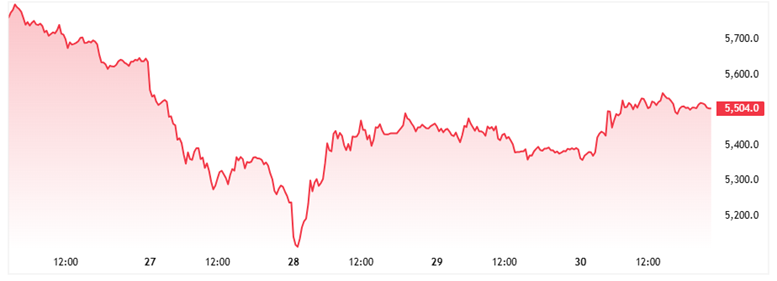
Figure 1: Lukoil (LKOH.MM) stock price, 24 – 30 October 2025.
The data above displays Lukoil’s stock price between the 24th and 30th of October. This date shows how since the announcement of the sanctions on October 23rd, Lukoil’s stock price fell from 5,700 Russian Rubles on the morning of October 24th to 5,505 Rubles by the evening of October 30th, reflecting a decline of approximately 3.4%. This short-term drop displays an instant market reaction and illustrates initial investor concern over the implications of the sanctions. The sharp change in
Lukoil’s stock price shows how swiftly financial markets respond to geopolitical developments and therefore signal broader uncertainty for Russia’s energy sector and the potential for sustained economic pressure.
Besides the swift changes in stock prices, the sanctions also influenced global oil trade flows. The EU’s continuous sanctions since the start of Russia’s invasion of Ukraine, compelled Russia to redirect its oil exports eastward and thus focus on markets in China and India. However, in the wake of the United States’ sanctions, both China and India have exhibited signs of caution in their approach towards their dealings with Russian oil suppliers. Despite opposing unilateral sanctions, Chinese national oil companies have temporarily halted imports of Russian crude from Rosneft and Lukoil to avoid potential U.S. penalties. Additionally, while maintaining a cautious diplomatic stance, Indian refiners have largely paused purchases of Russian oil linked to sanctioned firms, instead seeking supplies from non-sanctioned sources (9). The reaction of these major buyers demonstrates the effectiveness of the United States’ sanctions in reshaping global trade. China and India’s cautious behaviour reinforces the growing influence of secondary sanctions as a deterrent tool and underscores the overall seriousness of the United States’ sanctions. If even Russia’s largest customers are adjusting their trade to avoid penalties, then it is evident that Russia must also take these sanctions seriously. With a substantial decrease in revenue from key buyers, Russia’s economy is under increasing strain, threatening its fiscal stability and limiting resources available to sustain government spending and particularly their ongoing military operations in Ukraine.
Implications & Outlook:
The United States’ sanctions on Rosneft and Lukoil marked a significant escalation in the West’s economic strategy against Russia. These sanctions directly targeted the core of Russia’s oil economy and aimed to disrupt a vital source of revenue for Russia and its ability to continue its prolonged war in Ukraine. The immediate market reactions, from falling share prices to disrupted trade flows, in turn shows how closely interlinked geopolitics and global energy markets have become.
The sanctions are already causing major buyers like China, India and Turkey to halt purchases (10), which in turn demonstrates the effectiveness of the measures in creating immediate economic pressure and signalling the serious risks of U.S. penalties and secondary sanctions for those who continue trading with Russia. Western allies, especially those integrated into the U.S. financial system or dependent on American trade, are also expected to reduce or halt transactions with Rosneft and Lukoil to avoid secondary sanctions and reputational risks.
However, the long-term effectiveness of these sanctions remains uncertain.
Although China and India are temporarily complying in the short term to minimise immediate exposure to U.S. penalties, both countries maintain strategic energy and economic ties with Russia. Therefore, it is possible that they would resume or even increase transactions once short-term pressures ease. Their future decisions will likely depend on balancing the risks of U.S. secondary sanctions against the economic benefits of continued access to Russian oil.
In the broader geopolitical context, these sanctions display the United States’ sustained commitment to applying economic pressure on Russia in response to its aggression in Ukraine. Furthermore, they also serve as a warning to other states about the potential costs of aligning with or supporting sanctioned regimes. Over the coming months, close monitoring of oil market volatility and Russia’s fiscal responses will reveal the full extent of the impact of these sanctions.
Ultimately, the sanctions on Rosneft and Lukoil shows the world that economic and financial power has become one of the most decisive tools in shaping global politics and influencing the behaviour of states in modern conflicts.
Citations:
1. EU, 2025
2. Reuters, 2025
3. BBC, 2025
4. World Benchmarking Alliance, 2023
5. The New York Times, 2022
6. CNN, 2025
7. Matheny, R.L., 2025
8. U.S. Department of the Treasury, 2025
9. Energy Intelligence, 2025
10. Bloomberg, 2025
Reference list:
BBC (2025). US sanctions Russian oil companies after failed Putin talks. BBC News. [online] 22 Oct. Available at: https://www.bbc.co.uk/news/articles/cd6758pn6ylo.
Bloomberg (2025). Russia’s crude deliveries plunge as US sanctions begin to bite. [online] The Economic Times. Available at: https://economictimes.indiatimes.com/industry/energy/oil-gas/russias-crude-oil-deliveries-plunge-as-us-sanctions-begin-to-bite/articleshow/125100246.cms?from=mdr.
CNN (2025). Crushed by punishing US sanctions, Russia’s Lukoil accepts offer to sell its international business. [online] CNN. Available at: https://edition.cnn.com/2025/10/30/business/lukoil-to-sell-foreign-assets-gunvor-intl.
Energy Intelligence ed., (2025). New Russia Sanctions Again Upend China, India Crude Buying. [online] Energy Intelligence. Available at: https://www.energyintel.com/0000019a-2fd8-ddaf-ab9f-afdbdb130000.
EU (2025). EU sanctions against Russia. [online] Consilium. Available at: https://www.consilium.europa.eu/en/policies/sanctions-against-russia/.
Matheny, R.L. (2025). Crude Awakening: United States Sanctions Rosneft and Lukoil. [online] Goodwinlaw.com. Available at: https://www.goodwinlaw.com/en/insights/publications/2025/10/alerts-otherindustries-crude-awakening-ofac-sanctions-rosneft-and-lukoil.
Reuters (2025). The two Russian oil giants hit with US sanctions. Reuters. [online] 23 Oct. Available at: https://www.reuters.com/business/energy/us-sanctioned-russian-oil-majors-rosneft-lukoil-2025-10-23/.
The New York Times (2022). Lukoil, a Russian Oil Company, Calls for an End to the Ukraine War. The New York Times. [online] 3 Mar. Available at: https://www.nytimes.com/2022/03/03/business/energy-environment/lukoil-russia-oil-ukraine.html.
U.S. Department of the Treasury (2025). Treasury Sanctions Major Russian Oil Companies, Calls on Moscow to Immediately Agree to Ceasefire. [online] U.S. Department of the Treasury. Available at: https://home.treasury.gov/news/press-releases/sb0290.
World Benchmarking Alliance (2023). Oil and Gas Benchmark. [online] World Benchmarking Alliance. Available at: https://www.worldbenchmarkingalliance.org/publication/oil-and-gas/companies/rosneft-2/.
