Risk Dynamics in Argentina’s Emerging Lithium Market
By Dmitriy Gasilin
Introduction:
Lithium’s standing as a critical mineral has been vital to the Electric Vehicle (EV) industry. Its role in revolutionising battery technology and storage is undeniable. Countries with reserves are racing to invest resources into mining and extraction, with Australia leading the way. Argentina is another key player, forming South America’s Lithium Triangle with Bolivia and Chile. Argentina offers an interesting opportunity for potential investors, although unstable legal and economic environments have aggravated the risk.
Argentina’s Lithium Potential:
As a region, Latin America is responsible for supplying 35% of the world’s lithium. Argentina is the fourth largest global producer at 6%, two places behind Chile which currently supplies 26% [1]. Despite this, Argentina’s lithium output experienced an increase of 65% in 2023, showing signs of healthy growth, according to the International Energy Agency [2]. The International Monetary Fund estimates that Argentina’s lithium exports could bring in $12 billion between 2024 and 2030, these exports could provide the country with $12 billion between 2024-2030, owing to a favourable investment environment and general macroeconomic stability [3].
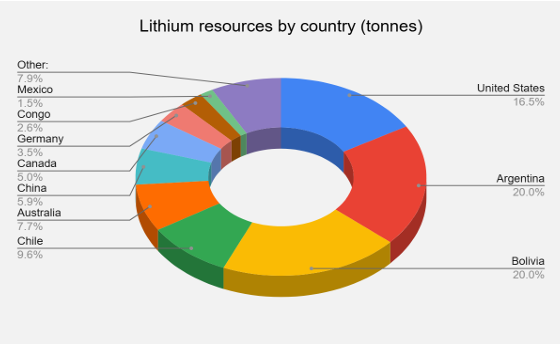
Figure 1: Measured and indicated lithium resources by country. Data from U.S. Geological Survey, Mineral Commodity Summaries, January 2025.
According to Figure 1, Argentina and Bolivia have the joint highest proportion of measured and indicated lithium resources in the world at 21 million tonnes. This is double the amount possessed by Chile, and over 16 million tonnes higher than the USGS’s revised figure for China. When examining the momentum behind medium-term lithium supply growth, Argentina’s Fenix facility appears among the eight fastest expanding lithium projects in the world, signalling the readiness of stakeholders to realise its resource potential [2]. Additionally, nearly 25% of planned additional chemical projects focused on lithium carbonate across 2024-2035 are expected to emerge in Argentina, amplifying the country’s role in chemical processing. This is crucial as lithium carbonate is the raw material used in LFP batteries used by manufacturing giants such as Tesla, Ford and BYD to power their new EV lines [4].
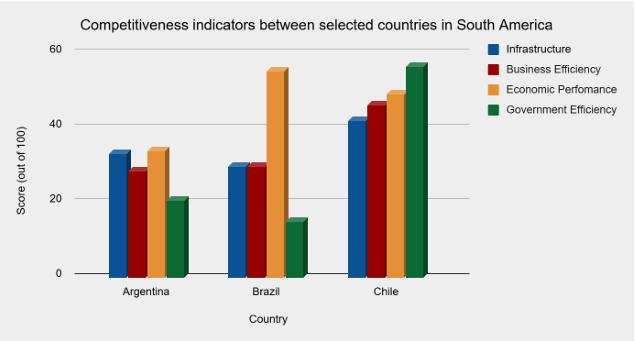
Figure 2: Country scores across selected South American countries, based on 4 measures of competitiveness. All scores are out of 100. Data from World Competitiveness Ranking: IMD, 2025.
This graph demonstrates that despite Argentina trailing behind Chile across all measured indicators, it does outperform the regional power Brazil in some metrics. For instance, Argentina has a higher infrastructure score (33.2), as opposed to Brazil (29.8). A reliable infrastructure ensures companies achieve operational efficiency throughout the lithium supply chain, and is a fundamental factor in determining Argentina’s chances of competing with Chile’s current productivity. The data offers some positive signals, however, these scores reinforce concerns over government efficiency and economic performance, presenting Argentina as a riskier investment opportunity in comparison to its fellow regional and global rival - Chile.
Risk analysis:
Political and economic risks
In 2025, Argentina’s leadership has been tested. Strong performance in the midterms by incumbent President Javier Milei points to further neoliberal reform and an expectation that growth remains a key mission. However, opinion polls and voting intent prior to the election pointed at growing support for the opposition party, indicating that shifting power dynamics should not be ruled out in future elections and leadership contests [5].
Argentina’s economic outlook in 2025 is more optimistic. Domestic demand is showing surprising levels of robustness and inflation is expected to fall to around 20-25% by the end of 2025 period [6]. Further progress is conditional on providing foreign investors with predictability across tax and regulatory environments, accompanied by targeted investment in public infrastructure projects in cooperation with private sector stakeholders and provincial governments. Deregulation remains central to government reforms, with medium-term impact dependent on adoption of sustainable transparency measures as restrictions are lifted. The outcome of market reforms also relies on reversing the downward trend in employment and securing labour mobility for sectors benefitting from comparative advantage, particularly mineral extraction and processing.
Recommendations:
Doubts over the results at the midterm elections reinforces the importance of monitoring public sentiment and its response to policy shifts, especially when characterised by local and regional protest. Fragility of future government support should not be discounted and is closely tied to support President Milei receives from the US, along with America’s willingness to assist Argentina by providing bailouts [6]. In response to economic challenges, firms should monitor how the government acts based on IMF recommendations, including compliance with Argentina’s stabilisation plan aimed at recalibrating economic errors made in 2023 [3].
Regulatory risks
Potential investors should be mindful of inconsistencies between the IRMA (Initiative for Responsible Mining Assurance) standard and domestic legislation. A key regulatory divergence consists of IRMA requiring a record of consent obtained from indigenous communities to gain project approval, while national legislation is satisfied by a consultation only [7]. Such an environment can create a scenario where even if a company follows legal national guidelines, they can still be failing to adhere to the best industry practices. Arrangements are made under Article 124 of the National Constitution, whereby provincial governments are able to regulate actions affecting resources they oversee, and can therefore either grant or decline mining licenses [8]. While they must do so under the Mining Code and Mining Investment Law, lithium does not have official recognition as a strategic resource. Provinces can independently declare lithium under this status and are free to seek additional income from production through local energy strategies, as evidenced by corresponding regulation that was implemented in the Jujuy province in 2011.
Additionally, information disclosed when submitting EIA’s (Environmental Impact Assessment) is often scrutinised, with procedures initiated based on (Free, Prior, and Informed Consent) FPIC [9]. Decisions on enforcing protections guaranteeing Indigenous rights depend on the social pressure facing provincial governments and their stance. For instance, the 2020 Lhaka Honhat v. Argentina ruling by the Inter-American Court of Human Rights favoured the strengthening of policies in favour of Indigenous communities [10]. As expected, struggle and protest is most prominent in regions with Indigenous populations that have, such as in the Catamarca and Jujuy provinces.
Recommendations:
Understanding local environmental guidelines is imperative, including EIA assessments or similar documentation relating to environmental impact. If these are not comprehensive the risk is arguably higher, as community pressure can facilitate emergency implementation by a provincial government. Businesses are advised to gain familiarity with provincial legislation, including any documentation released by relevant legislative bodies, along with preparedness to communicate with representatives of provincial administrations directly. When cooperating on existing projects or applying for approval, considerations should cover if the project threatens existing or proposed FPIC (Free, Prior and Informed Consent) guidelines. Circumventing regulations and taking advantage of loosely defined legal phrasing incurs a risk of accumulating legal penalties and reputational damage. Engaging in IRMA practices (Initiative for Responsible Mining Assurance) would be advisable to satisfy environmental impact concerns. Fundamentally, deregulation neither frees companies of corporate responsibility, nor should it encourage them to abandon their obligations under ESG (Environmental, Social and Governance) frameworks.
Conclusion:
Argentina offers an opportunity to invest in a lithium sector experiencing active growth, with a strong outlook for generating much needed export revenue. Understanding why this country is an interesting option stems from diving into its investment policies, founded on a neoliberal approach. While Argentina’s current political order is far from secure, there are more profound challenges beyond government popularity. By selecting Argentina, an investor must be prepared for a dynamic regulatory environment characterised by both decentralised control of mineral resources and rising deregulation, but where socially engineered checks and balances evidently exist.
Citations:
1. IEA, 2023. Latin America’s opportunity in critical minerals for the clean energy transition.
2. IEA, 2025. Global Critical Minerals Outlook. Available from:
3. IMF, 2024. Seventh Review Under the Extended Arrangement Under the Extended Fund Facility, Requests for Rephasing of Access, Extension of the Arrangement, Waivers of Nonobservance of Performance Criteria, Modification of Performance Criteria, and Financing Assurances Review.
4. EVDB New Zealand. Which Cars Have LFP Batteries?
5. Financial Times. 2025. Argentina’s Javier Milei hails ‘historic’ win in pivotal elections.
6. IMF, 2025. First Review Under the Extended Arrangement Under the Extended Fund Facility, Requests for a Waiver of Nonobservance of a Performance Criterion,Rephasing of Access, Modification of Performance Criteria, and Financing Assurances Review.
7. Kramarz, T., Victoria, M., Allan, T., Escosteguy, M., Kingsbury, D. and Seghezzo, L. 2024. Redundancies, layers, and dilemmas: Comparing private standards and public regulations in lithium mining.
8. Cretini, I.O. and Robert, V. (2025). From lithium to batteries: Opportunities and challenges for linking Argentina’s lithium extraction to national industrial development.
9. Mahiques, V.A., Allan, T., Escosteguy, M., Kramarz, T. and Kingsbury, D., 2024. Convergence, divergence or mixed-results? A comparison between private and public rules governing lithium mining in Argentina.
10. Indigenous Peoples and the Energy Transition: Mining and Pollution in Argentina.
11. USGS, 2025. Mineral Commodities Summaries 2025: Lithium.
12. IMD, 2025.World Competitiveness Ranking.
