Assessing Guinea’s Bauxite Sector: Strategic Risks and Opportunities for Global Investors
By Max Leyshon
Introduction
With an estimated 7.4 billion tonnes, Guinea controls the world’s largest bauxite reserves, accounting for nearly one-quarter of global supply.[1]. Bauxite is the world’s primary source of aluminium which is highly sought after by Western and Chinese manufacturers for the automotive, aerospace and energy industries. Currently, Guinea is the second largest exporter globally, behind Australia, however with current growth projections it is expected Guinea will overtake Australia this decade. Realising this will require both a steady influx of foreign investment and a stable political environment. This report examines the potential growth of Guinea’s bauxite industry, the potential risks for investors and the implications on global trade.
Market Context
Over the past decade, the expansion of Guinea’s bauxite sector has been driven primarily by China and Chinese backed companies. Chinese controlled firms are responsible for 60% of the shipments of bauxite out of Guinea in 2025, with the leading driver of this being SMB, they have exported 99.8 million tonnes of bauxite so far this year[2]. Guinea is the largest seaborn bauxite exporter worldwide accounting for 73% of global bauxite shipments[3]. This dominance is expected to grow, with forecasts predicting a rise in bauxite export value in 2033 to be 125.9 billion USD compared to 84.5 billion USD in 2025.
China’s influence
The influence of China over the bauxite industry in Guinea is a clear example of China’s wider strategy to establish their own infrastructure and supply chains in sub-Saharan Africa. This strategy allows China to control access to the raw material and streamline the value chain of aluminium from mining to production. As stated, SMB is a leading driver of bauxite industry growth in Guinea, the company was created as a consortium between Guinea and China to exclusively support the production of aluminium in China. The expansion into Guinea by China was caused by Indonesia’s ban on bauxite exports in 2014, this forced China to find other producers who could support their demand. Chinese investors have since built entire logistics chains in Guinea, most notably the Dapilon-Santou railway, specifically dedicated to moving bauxite from the mine to the port, this cost investors $1 billion. The size and cost of these infrastructure investments demonstrate China’s commitment to dominate the global bauxite supply chain.
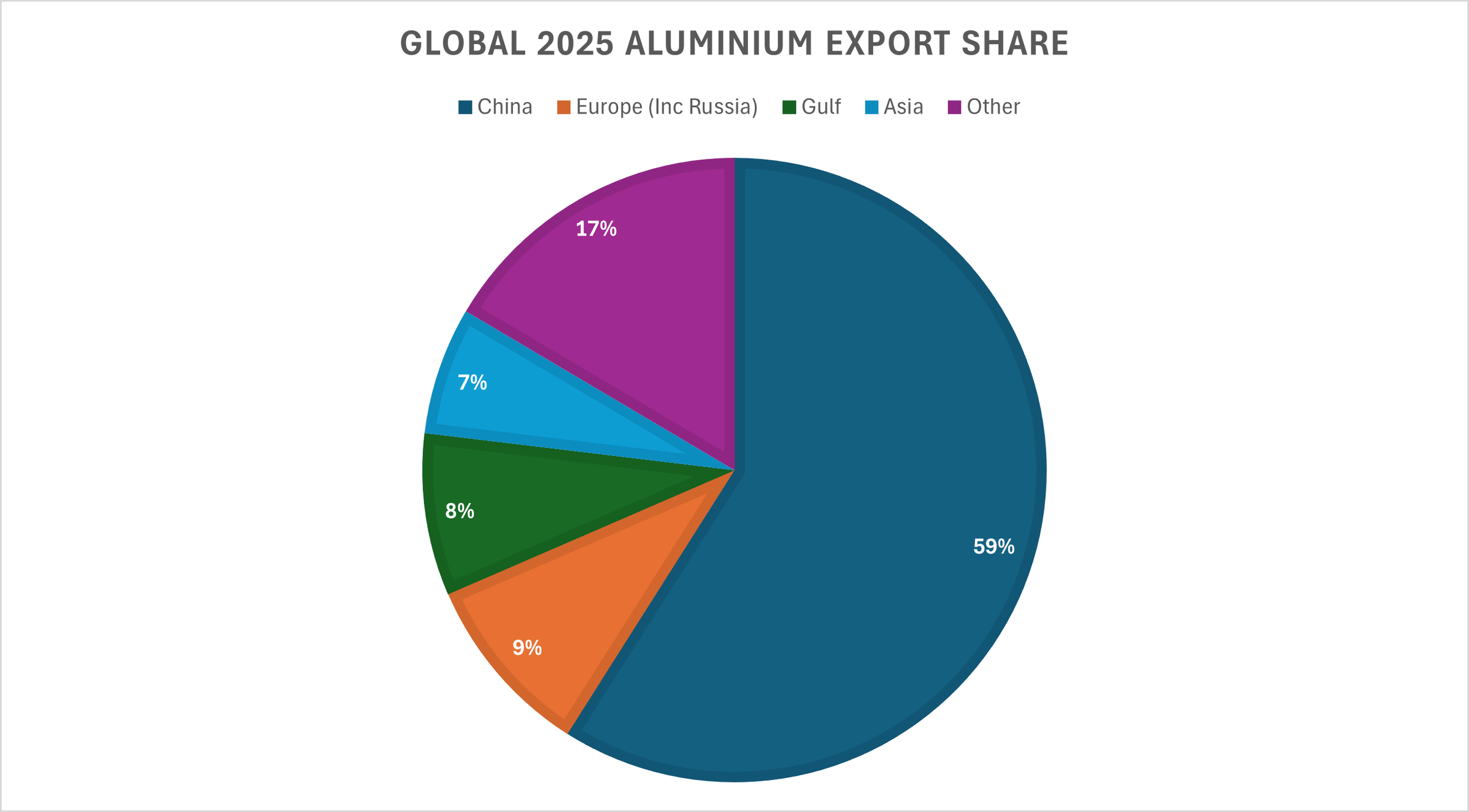
Figure 1: Aluminium Export Volumes by Area
The diagram demonstrates China’s global dominance in aluminium exports in 2025; this is only possible due to the bauxite supply from Guinea which is subsequently refined in China and then exported globally.
Political Risk
The main risk for potential investors in Guinea is political instability. Since 2021, there has been a military government in place, after the incumbent leader Alpha Condé was ousted due to suspicions of corruption. The new military government has postponed multiple elections and has created an unstable political environment for investors.
Furthermore, this political volatility has been compounded by sweeping regulation changes affecting miners and foreign entities, often without any consultation to stakeholders. A key example of this has been a decree ordering all miners to build aluminium refineries or risk losing their mining license. These refineries can cost between $1-$3 billion to build and many miners operate an export only model. With timelines for these infrastructure projects often taking between 5-7 years, an investment of this size would be a be risk in the current political climate, especially when the future looks so uncertain.
Dependency Risk
The main structural risk surrounding Guinea and the bauxite industry is its over reliance on China and Chinese investment. China is not only the major importer of Guinean bauxite but also by far the main investor in infrastructure in the country. This poses as a large barrier to entry for new investors in the region, with non-chinese investors struggling to gain access to railways, ports and political support due to the Guinean alliance with China. This quasi-monopolist system does not foster itself to new investors, and any new investors should be aware of this dynamic.
However, this could cause Guinea to be vulnerable to large falls in national revenue, due to the lack of diversification in their exports. Consequently, China’s involvement in Guinea should be closely monitored as changes in the political environment or policy could create a golden opportunity for new investors. If China withdraws from the country, it will leave a gap that others can move in to fill.
Current Forecasts
Current forecasts predict an increase in bauxite production in Guinea. Precise long-term production forecasts remain limited due to operating conditions in Guinea's bauxite sector changing rapidly. Factors such as regulatory decisions, weather disruptions, infrastructure constraints, and shifting government policies on mining and refining make future output difficult to predict with high confidence.
Although, based on recent reports we can expect the Guinean bauxite industry to continue growing, in 2024 production was 135 MT, and this has grown to an estimated 160 MT in 2025. Guinea has seen an increase of around 20% in production capacity in the midst of political turmoil[4]. Guinea’s bauxite sector has proven remarkably resilient to political uncertainty, consistently delivering double-digit growth and record output even amid governance transitions and regulatory changes. Hence, investors and importers can expect Guinean bauxite to continue its dominant growth until at least 2030.
Impact on Shipping
This year, due to the rapid growth of bauxite exports, there has been a sharp increase in demand for vessels. Handymax vessels have seen the largest surge in demand. Within the last year Handymax cargoes leaving Guinea have increase from 1.8 MT to 5.0 MT[5]. This has caused Handymax positioning to decrease in South America and increase off the west coast of Africa as ships reposition themselves to take advantage of this increased demand. Furthermore, tonne mile averages have increase for Handymax vessels this year, this has been caused by an increase in voyages to China compared to Europe. With China’s dominance in the region, this trend is expected to continue, and brokers should be aware of this change, and any potential bottle necks that could occur with Handymax supply.
Outlook for Potential Investors
The strategy now for potential investors should be grounded in a long-term version, mainly due to the current junta’s new compliance laws. Quick and short-term investment is no longer viable due to these new regulations stipulating the building of aluminium processing plants if mining licenses are to be granted. Instead, investors should look to partner with the Chinese firms already mining and take advantage of their infrastructure and experience in the region. Furthermore, investors should prioritise building alliances with local firms, especially with the new requirements that Guinean firms need at least a 15% stake in any new deals. A winning investment strategy in this region would be to have a minor investment in larger deals led by Chinese firms, this allows investors to gain from the incumbent successful firms and build meaningful long-term relationships with the main players in the bauxite industry, and places investors in a strong position when downstream processing begins in Guinea over the next 5 years.
Conclusion
Guinea’s bauxite sector remains a standout opportunity for investors with world topping reserves, strong Chinese demand, and a decade of built infrastructure. Despite political noise and fast changing regulation, the industry has managed to prosper at unrivalled rates. Short-term flips are over, but patient investors who partner with established Chinese operators, take minority stakes with credible local partners, and commit to the government’s refinery roadmap will secure long-term rewards in Guinea and remain poised for the growth of the aluminium refinery boom in the coming years.
Citations
[1] African Development Bank Group: Critical mineral insight (Bauxite)
[2] Reuters: Guinea bauxite exports up 36% to 99.8 million tonnes on Chinese demand (07/25)
[3] Kpler: The future of Guinea’s position in global bauxite trade and its alumina ambition
[4] Project Blue: Guinea’s push towards recourse nationalisation and its impact on the bauxite market
[5] SSY: Handymax increase in West Africa exports
