Beyond Trade: The Strategic Implications of the India-EU Summit
By Charlie Cameron
Introduction:
The recently concluded summit between India and the EU hosted in New Delhi has opened a new chapter in the strategic partnership between these two large global players. In their 16th ever summit, they successfully concluded an EU-India Free Trade Agreement (FTA), and launched an EU-India Security and Defence Partnership. These two agreements underscore the potential and determination of both partners to shape one of the defining partnerships of the 21st century. While trade and bilateral cooperation were the headline deliverables, the real significance of the new agreements lies in how it reshapes India’s strategic position against China, and how the new nature of this relationship post-summit, as well the deals made at the summit, will affect the global order in the coming months and years.
What the Summit Delivered:
Rather than being a routine display of symbolic diplomacy, the summit had strong and clear strategic goals that were achieved. Reinforcing the importance of trade as a geopolitical stabiliser, the two parties successfully completed negotiations on the India-EU free trade agreement. The EU and India account for almost one fifth of global trade, with the EU being India’s second largest trading partner, ahead of the US and behind China, representing 11.5% of traded goods for India. The graph below shows the consistent growth in the trade relationship between these two powers, and alongside the encouraging nature of the data is the sheer size of the relationship, leading to the overwhelming positivity surrounding this deal.
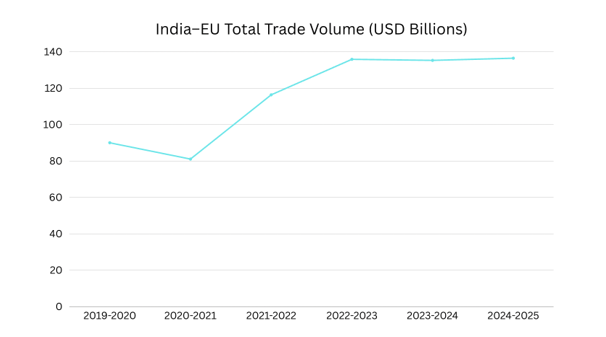
Source: Ministry of Commerce and Industry (India)
Alongside the FTA came a security and defence partnership, boosting cooperation and targeted dialogue in maritime security, cyber threats, defence industries and technologies, and counterterrorism among others. Through this security partnership, India and the EU are making their relationship more than just a trade-centric one. It also signals European interest in India as a partner in Indo-Pacific security and global stability, as in October 2025 the European Council approved conclusions on the implementation of the EU strategy for cooperation in the Indo-Pacific stressing that the EU should further intensify its strategic focus and presence in the region to help contribute to continued stability and development in the region. This new security partnership will only serve to strengthen the EU’s presence in this area of the world.
Among the other significant points at the summit, India reinforced their ongoing support efforts for peace in Ukraine, as well as their desire for dialogue in diplomacy in the Middle East region, particularly the recent violent developments in Iran and the need to help find a peaceful solution. The summit also formalised a broader Joint Comprehensive Strategic Agenda, expanding cooperation in investment, innovation, digital infrastructure and climate action. Commitments to resilient supply chains, research collaboration, clean energy, and environmental sustainability reinforced the depth of the partnership [1]. Collectively, these agreements signal a deliberate shift towards a long-term, multidimensional India-EU relationship with implications extending well beyond immediate geopolitical pressures.
India, China, and the Strategic Meaning of the Summit:
Aligning with India’s typical foreign policy strategy, the summit signals their commitment to strategic autonomy, and their longstanding avoidance of entering binding alliances (particularly militarily) dating back to their independence in 1947 where leaders pursued non-alignment. The FTA reached by India and the EU has created the largest free trade zone in the world, a zone that India will take full advantage of to further diversify their trade portfolio [2]. Through this summit, India has deepened their formal ties with the EU without formally aligning against one of their biggest trading partners but also biggest threats, China. Bolstering trade between India and the EU will attract a large amount of European capital away from Chinese markets, similar to multinationals in recent years who have adopted “China-plus-one” strategies. These strategies aim to maintain the businesses operations in China while diversifying production to alternative markets to reduce geopolitical and supply-chain risk, often in countries such as Vietnam, Indonesia, and India [3]. By locking in preferential market access and regulatory coordination between two of the world’s largest economies, this FTA lowers the transaction costs of relocating or expanding production in India. For European firms seeking to diversify beyond China, India now represents a commercially viable alternative beyond simply a political one.
Symbolism in international politics is crucial, and while the security agreement reached between India and the EU doesn’t include any mutual defence clauses or commitments, India will begin to embed themselves institutionally in European strategic frameworks, specifically in the Indo-Pacific region. Although the agreement preserves India’s own strategic autonomy without the inclusion of any alliance agreement, Beijing will view this move as part of a broader plan of gradual integration into non-China security networks [4]. Through their formal engagement with India on maritime and cyber security, the EU reinforces India’s status as a legitimate provider of regional stability. Significant also the backdrop of the ongoing and unresolved border disputes between India and China, as well as China’s position as defence partner with India’s deep historical rival, Pakistan. The India-EU partnership quietly broadens India’s strategic options and increases the diplomatic and reputational costs for any future Chinese pressure, without openly heightening confrontation.
Implications for the Rest of the World:
Further integration between two of the leading players on the global stage will play its part in accelerating diversification away from China, and reduced trade tariffs between these powers will put pressure on other economies to reduce their trade barriers to remain competitive. This huge display of cooperation is also an incredibly important signalling of the confidence both India and the EU have in long-term, rules based systems of trade in a time of fragmentation. In keeping with the other symbolic qualities this deal possesses, a shared belief in institutionalised economic governance is displayed despite a wider shift towards protectionism being seen across the globe [5]
The outcomes of the summit also highlight the accelerating development of a multipolar world order, in which power is distributed across numerous major actors rather than belonging to one or two. India now occupies the rare position of a swing power, linking Europe, the Indo-Pacific, and the broader Global South through overlapping economic and strategic partnerships. The growing relationship India has with the EU does not stall its engagement with other centres of power, but enhances its ability to move between them and extract all benefits while avoiding any rigid alignment. The EU’s engagement with India also signals their own growing assertion of strategic autonomy, showing that they are willing to shape their own Indo-Pacific and Global South relationships rather than operating mostly through transatlantic frameworks. For the Global South, this convergence carries significant implications. India is promoting themselves as an alternative investment and trade partner to China, offering emerging economies options beyond a Beijing-centric model [6]. Their positioning as a bridge between advanced industrial economies and developing states reinforces their standing as a mediator of interests across economic divides. Other states now may also pursue similar diversified partnerships, spreading themselves more actively between China, India, and Western powers to maximise their strategic flexibility and reduce dependence on a single power.
Conclusion:
The success of the summit marks a significant step in reshaping contemporary geopolitics. Through the combination of a landmark free trade agreement with a new security partnership, both sides have strengthened their long-term strategic alignment without formalising any rigid alliance. For India, the agreements expand economic and diplomatic spacing in managing competition with China, and for the EU, a deeper engagement in the Indo-Pacific reflects growing geopolitical ambition. The summit reinforces an emerging multipolar order, encouraging diversification, flexible partnerships, and renewed confidence in rules-based cooperation amid global fragmentation.
References:
[1] https://www.consilium.europa.eu/en/meetings/international-summit/2026/01/27/
[2] https://www.weforum.org/stories/2026/02/india-eu-mother-of-all-trade-deals-what-to-know/
[3] https://www.fedex.com/en-nz/small-business/streamline-operations/china-plus-one-strategy-guide.html
[4] https://www.epc.eu/publication/why-geopolitics-not-just-trade-finally-sealed-the-euindia-deal/
